
TL;DR
A main sewer line clog can slow or back up several drains in your home. It affects the shared pipe that carries wastewater away from your property.
Common causes include tree roots, grease and debris buildup, mineral and scale buildup on the pipe walls, corrosion, or a pipe that has simply aged out.
When several fixtures are affected, the next best step is to limit water use and schedule a sewer camera inspection to confirm the cause of blockage and the right fix.
A main sewer line clog is one of the calls TID Trenchless takes most often across Greater Boston and Southeastern Massachusetts. It usually shows up as repeated signs: a gurgling toilet when you run the washing machine or a shower that suddenly backs up. It slowly affects more than one drain in your home.
Clogs show up most in older homes, from Cambridge and Newton to a mix of historic and newer properties out toward Plymouth and New Bedford. TID Trenchless works on lines like these across its Massachusetts service areas every week. Much of the housing in these communities went up well before 1980, when clay, cast iron, and Orangeburg pipe (a fiber pipe used from the mid-1940s into the early 1970s) were the standard materials. Clay lines usually last 50 to 60 years. Cast iron runs 50 to 100. Orangeburg often gives out in under 50. A lot of these pipes are now at or past the end of that window. Add root intrusion, corrosion, shifting joints, and scale buildup, and flow gets a little tighter every year.
In this guide, TID Trenchless explains what a main sewer line clog is, warning signs to look for, what causes the clog, and what you can do next.
What Is a Main Sewer Line Clog?
A main sewer line clog happens when debris, tree roots, or corrosion blocks the primary pipe carrying wastewater from your home to the municipal sewer or septic system. Every fixture in your home, from kitchen sinks to tubs and showers, connects to this shared line. When that line is blocked, more than one drain in your home backs up at the same time.
Aging pipes, corrosion, cracked lines, shifting joints, and gaps all make it easier for waste to build up inside the pipe. Understanding the cause and signs of a sewer line clog helps determine the right service to clear it.
Signs of a Main Sewer Line Clog
A sewer line clog usually shows itself in patterns, rather than one isolated symptom. The more fixtures are involved, the deeper the blockage usually sits.
Here are a few common signs a main sewer line is clogged:
Several Drains that Back Up At the Same Time: If sinks, tubs, showers, or toilets start to drain slowly at the same time, the clog may include more than one fixture.
Gurgling Toilets or Drains: Restricted water flow traps air within the line, which eventually escapes through nearby fixtures in the form of bubbling or gurgling sounds.
One Fixture Backs Up When Another is Used: Water can rise up in a toilet when the washing machine runs, or the shower fills up when you flush the toilet.
Recurring Clogs: A sewer line that keeps clogging after it has been cleared usually has roots, mineral buildup, or corrosion catching debris inside the pipe.
One of these signs may point to a localized clog, but two or more symptoms are a strong signal the main line is involved. TID Trenchless also breaks down the 7 warning signs of a broken sewer line and what each one usually means. Identifying whether the problem is structural or a localized blockage helps shape the right sewer service.
Is It a Clogged Drain or a Main Sewer Line Clog?
The easiest clue is to look at how many fixtures are affected. A local drain clog usually causes backup on one sink, tub, shower, or toilet. A main sewer line clog affects several fixtures throughout the home, as they eventually drain into the same pipe.
Here’s how you can tell when it’s a clogged drain or a main sewer line clog:
| What You Notice | Local Drain Clog | Main Sewer Line Clog |
|---|---|---|
| Fixtures affected | Affects one fixture only. | Often multiple fixtures at once. |
| Slow Drainage | One sink, tub, or toilet | Multiple drains at the same time. |
| Gurgling Sounds | Usually isolated in one fixture. | May happen across several fixtures, including toilet and sink, or toilet and washing machine. |
| Water backing up | Near the affected drain. | Often at lower-level drains. |
| Common causes | Hair, food debris, local grease | Root intrusion, buildup, or damage in the main line |
| Where the clog is | Branch drain | Shared main sewer line |
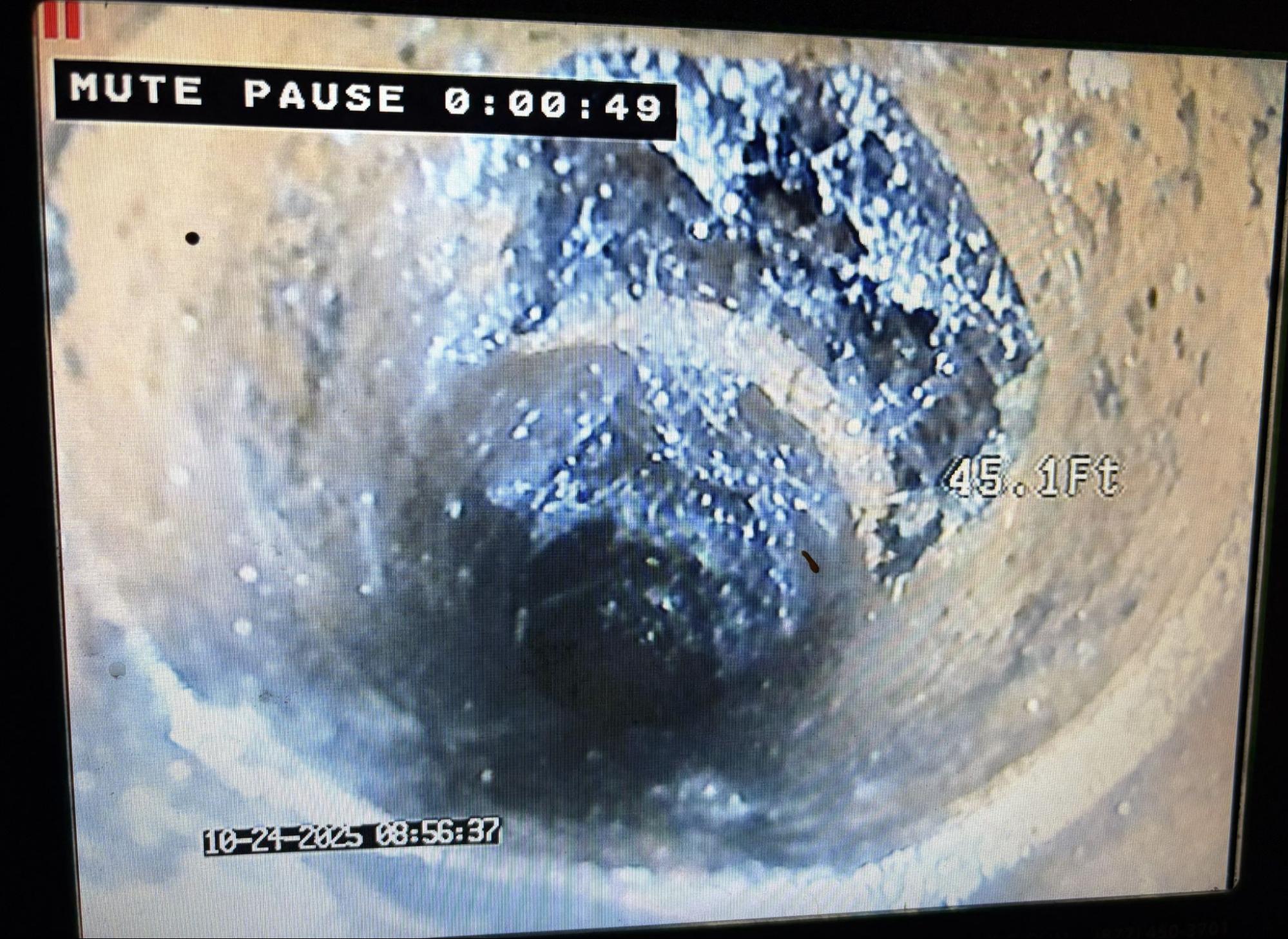
Scheduling a sewer camera inspection gives a clear view of the full line and pinpoints exactly where the blockage sits. It also gives a detailed view of the pipe’s condition before a cleaning or repair is recommended.
What Causes a Main Sewer Line to Clog?
There are several reasons that cause a main sewer line to clog. Some blockages are from debris, grease, and scale building up inside a sound pipe. Others slowly develop when the pipe sags, deteriorates, or is near the end of its lifespan.
Tree Root Intrusion
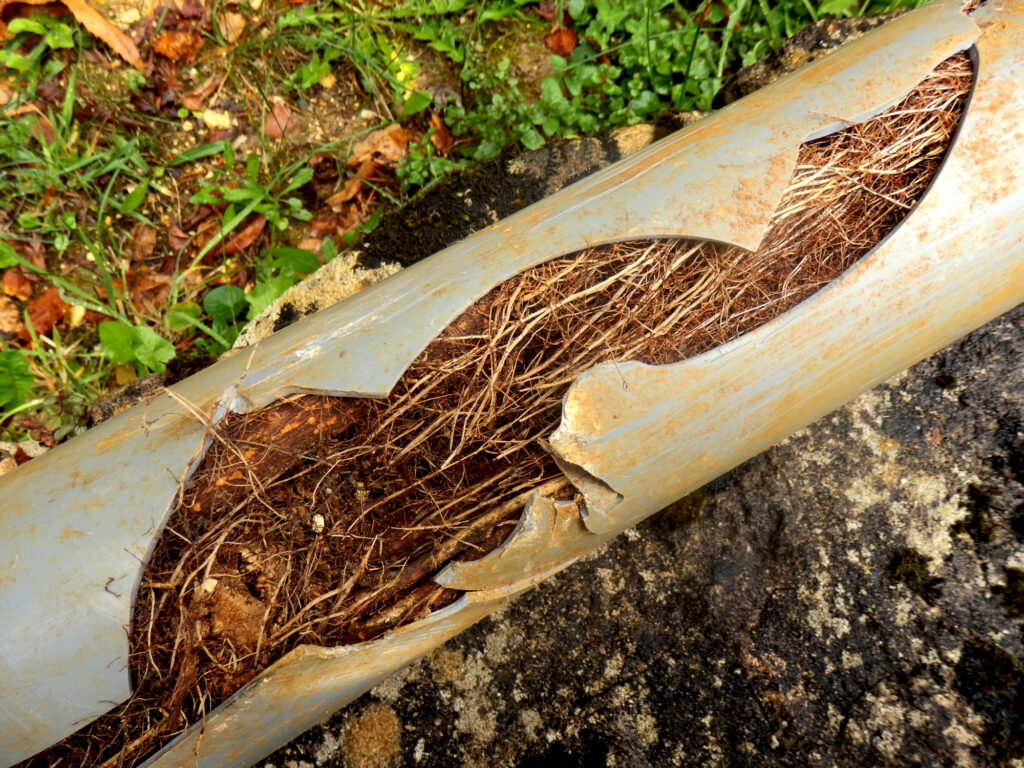
Tree roots naturally grow toward a source of moisture. If an aging sewer line cracks, loses a joint, or develops a small opening, tree roots can enter and grow inside it. These roots eventually catch small amounts of debris. Over time, this builds up and restricts wastewater flow, resulting in recurring backups.
Grease and Material Buildup
Fats, oils, grease, soap residue, and sediment gradually coat the walls of a sewer line. This limits the pipe opening and blocks proper flow. Older cast iron pipes with rough interior walls easily catch waste and debris as it moves through the line. It is a bigger factor than most homeowners expect. The U.S. EPA reports that grease causes 47 percent of reported sewer blockages.
Aging or Corroded Sewer Pipe
Aging sewer lines with years of corrosion and mineral buildup have narrow openings and rough interiors. Clay joints can separate or shift over time. Pipe sections also change shape when the surrounding soil moves over time. These conditions change how wastewater moves through each section and create spots where minerals and debris collect.
Cracks, Offset Joints, or Sagging Sections
Offset joints and low or sagging sections let water and solid waste collect instead of flowing downstream. This eventually blocks the pipe opening, resulting in clogs and restricted flow.
Pipe clogs do not develop overnight. That’s why a single backup or a recurring clog is worth a closer look.
What Should You Do If Your Main Sewer Line Is Clogged?
If you suspect your main sewer line is clogged, the first step is to avoid adding more wastewater to the pipe. Here are a few practical steps to help limit the problem, before the line is professionally inspected:
Reduce water use: Avoid using the washing machine or dishwasher, taking long showers, or repeatedly flushing toilets. This avoids added volume that results in a full backup.
Keep clear of sewage backups: If wastewater has already flowed into your home, keep the area free of people, pets, and any electrical appliances.
Skip store-bought chemical drain cleaners: Chemical cleaners cannot fix roots, loose joints, sagging pipes, or other structural issues. The chemical elements can also speed up corrosion instead of addressing it.
Avoid repeated DIY snaking: It can temporarily restore flow but the main cause of blockage is not fully addressed. This only results in repeated clogs.
Schedule a professional sewer inspection: Getting a professional sewer camera inspection helps identify the root cause of blockage, where it is located, and what service the pipe actually needs.
Getting the line assessed is the next practical step before choosing a cleaning or sewer repair method. What the inspection finds determines whether the pipe needs hydro jetting, which uses high-pressure water to scour buildup off the pipe walls, or a trenchless sewer repair that fixes the line without digging up the yard.
What If Your Home Is on Septic?
A lot of homes south of Boston are not connected to a municipal sewer at all. Plymouth runs mostly on private septic outside the downtown area, Plympton is almost entirely septic, and roughly 85 percent of Cape Cod homes are on their own systems.
The symptoms look identical from inside the house, but the cause is different. Multiple slow drains on a septic property often mean a full tank, a clogged outlet baffle, or a drain field that is no longer absorbing. A camera inspection still tells you where the line stands between the house and the tank, and it rules out a lateral problem before you spend money pumping a tank that was not the issue.
How Professionals Find and Clear a Clogged Main Sewer Line
Professional sewer clog services locate what is blocking the line and the root cause of the blockage. Each service starts with a sewer camera inspection, providing a real-time view inside the pipe. It shows whether roots, grease buildup, debris, corrosion, shifted joints, or cracks are causing the restricted flow.
From there, the service is matched to the blockage and pipe condition. No guesswork and not a one-size-fits-all fix. Depending on the findings, the fix may be drain cleaning, hydro jetting, or sewer pipe lining, which is a trenchless method that forms a new pipe inside the old one without digging.
TID Trenchless uses this camera-first approach across properties in Greater Boston and Southeastern Massachusetts. Our founder, John Shaw, has more than 13 years of experience in wastewater and underground infrastructure. That experience shows in how we take a closer look at the line first before recommending drain cleaning, hydro jetting, sewer pipe lining, or another trenchless sewer repair method.
How to Keep a Main Sewer Line From Clogging Again
Clearing a line solves today’s problem. Keeping it clear comes down to what goes into the pipe and what is growing around it.
Keep Grease Out of the Drain
Grease is the biggest one, and it is the one most people get wrong. Cooking oil, bacon fat, and butter go down the drain as a liquid and cool into a solid coating a few feet into the pipe. Every wash after that sticks to what is already there.
Running hot water behind it does not help much, because the grease just travels farther before it hardens. Let it cool in a can or jar and throw it away instead.
Flush Only Toilet Paper
Packaging that says flushable means the wipe will clear your toilet, not that it breaks down the way toilet paper does. It stays intact all the way into the main line, where it catches on roots or a rough patch of old pipe and starts collecting everything behind it.
The same goes for paper towels, cotton swabs, dental floss, and cat litter. Toilet paper and human waste are the only two things that belong in a toilet.
Watch What You Plant Near the Sewer Line
Roots are harder to control because they are not coming from inside the house. If you know roughly where your sewer line runs from the house to the street, avoid planting trees or large shrubs along that path. Willows, maples, and poplars are the usual offenders because they grow fast and chase moisture aggressively.
For trees that are already established, you are not going to move them. The realistic move is knowing they are there and watching for early signs.
Get Older Lines Checked Before They Back Up
If your home was built before 1980 and still has its original clay, cast iron, or Orangeburg line, a camera inspection every few years tells you what condition the pipe is actually in before a backup does.
That is not a maintenance plan pitch. It is just cheaper to find a cracked joint on a scheduled visit than on a Sunday night with sewage in the basement.
Worth being straight about what prevention can and cannot do. Good habits keep a sound pipe flowing. They do not repair a line that is already cracked, sagging, or full of roots. If the clogs keep coming back after the line has been cleared, the pipe itself is the problem, and no amount of careful flushing changes that.
Main Sewer Line Clog FAQs
How long does it take to fix a main sewer line clog?
The time it takes to unclog a main sewer line depends on what is causing the blockage and the pipe’s overall condition. Some localized clogs can be cleared during a single service visit, while roots, heavy buildup, or structural damage may require additional cleaning or pipe repairs. A sewer camera inspection identifies the blockage first, so the service, cost, and timeline can all be quoted accurately instead of estimated.
Is a main sewer line clog an emergency?
It depends on how far along it is. A single slow drain can usually wait a day or two. Once multiple fixtures are backing up, or wastewater is coming up through a basement drain, treat it as urgent. Stop running water in the house and get the line inspected before the backup reaches finished space, because that is when a repair turns into a cleanup.
Will cleaning fix a main sewer line clog, or do I need a repair?
The right fix depends on what caused the clog and the surrounding pipe’s condition. If the sewer line is structurally sound, cleaning or hydro jetting is usually enough. If the inspection shows a cracked or damaged section, a trenchless pipe repair is the right option. TID Trenchless starts with a sewer camera inspection to determine the right service for different clog issues.
Is the clog my responsibility or the city's?
In most Massachusetts communities, the homeowner owns the sewer lateral, meaning the pipe running from the house to the connection at the main in the street. The city owns the main itself. That means most main line clogs land on the homeowner, even when the blockage sits out near the curb. A camera inspection shows where the problem is relative to that property line, which matters before anyone starts quoting a repair.
How much does it cost to clear a main sewer line clog?
In the Boston and Southeastern Massachusetts area, clearing a clogged main line generally runs from about $250 for a straightforward snaking to $900 or more when hydro jetting or difficult access is involved. A sewer camera inspection typically falls between $290 and $500. The real number depends on what is causing the clog and how the line can be reached, which is why TID Trenchless looks first and quotes after.
How long does it take to fix a main sewer line clog?
The time it takes to unclog a main sewer line depends on what is causing the blockage and the pipe’s overall condition. Some localized clogs can be cleared during a single service visit, while roots, heavy buildup, or structural damage may require additional cleaning or pipe repairs. A sewer camera inspection identifies the blockage first, so the service, cost, and timeline can all be quoted accurately instead of estimated.
Is a main sewer line clog an emergency?
It depends on how far along it is. A single slow drain can usually wait a day or two. Once multiple fixtures are backing up, or wastewater is coming up through a basement drain, treat it as urgent. Stop running water in the house and get the line inspected before the backup reaches finished space, because that is when a repair turns into a cleanup.
Will cleaning fix a main sewer line clog, or do I need a repair?
The right fix depends on what caused the clog and the surrounding pipe’s condition. If the sewer line is structurally sound, cleaning or hydro jetting is usually enough. If the inspection shows a cracked or damaged section, a trenchless pipe repair is the right option. TID Trenchless starts with a sewer camera inspection to determine the right service for different clog issues.
Is the clog my responsibility or the city’s?
In most Massachusetts communities, the homeowner owns the sewer lateral, meaning the pipe running from the house to the connection at the main in the street. The city owns the main itself. That means most main line clogs land on the homeowner, even when the blockage sits out near the curb. A camera inspection shows where the problem is relative to that property line, which matters before anyone starts quoting a repair.
How much does it cost to clear a main sewer line clog?
In the Boston and Southeastern Massachusetts area, clearing a clogged main line generally runs from about $250 for a straightforward snaking to $900 or more when hydro jetting or difficult access is involved. A sewer camera inspection typically falls between $290 and $500. The real number depends on what is causing the clog and how the line can be reached, which is why TID Trenchless looks first and quotes after.
See What Is Blocking Your Sewer Line
If more than one drain in your home is backing up, the ideal next step is getting the sewer line looked at. A quick inspection tells you whether you are dealing with buildup, roots, or corrosion. It also points you to the right repair or cleaning service, instead of a repeat visit.
TID Trenchless serves homeowners across Greater Boston and Southeastern Massachusetts with a camera-first approach. Call our team at (781) 887-3937 for a free estimate or schedule an inspection.